


Spesbona, Spesbona angusta, Spesbona 


Short description:
Spesbona, Spesbona angusta, Spesbona is small sized, a slender, dark blue and black damselfly, which looks like a Sprite when first seen, but with strikingly long and curved appendages.
Previously known as Ceres Streamjack
Family Platycnemididae Yakobson & Bianchi, 1905
More Images:


Click on all images and links to enlarge
Previously known as Ceres Streamrjack, Metacnemis angusta
Note
A Spesbona specimen will change colour with increase in temperature. Blue parts will become almost white. The base colour of a female when old is dark brown almost deep purple brown with blue and purple markings Both colours change to light blue
General notes
Known currently from very few areas In the Western and Eastern, The small (hindwing 15-19 mm) S. angusta is one of Africa’s most unusual damselflies. The larva is unique with its horned head, spidery legs and frilled lamellae, as is the adult with its bulging posterior head border, acute pterostigmas and unique colour pattern. Hugging a bright surface (white sand, a dead stem) with their long legs, males rapidly turn from blackish brown through deep purple to bright violet blue as they warm up. The eggs are laid in aquatic plants close to the water surface; the larvae developing as pools filled by streams and rivers in winter dry up in summer. Despite its black slender legs, Spesbona is related most closely to Copera and especially Proplatycnemis of Pemba (Mozambique) and Madagascar, probably representing the last survivor of an ancient African damselfly fauna in the continent’s southern extreme.
Key identification features:
Male:
- Face greyish blue and black. Anteclypeus and postclypeus dull black,postclypeus with long black hairs. Frons greyish blue with blackish margin against postclypeus. Head bright greyish blue with distinct matte black,horn-shaped marking viewed from above. Neck black above,Neck black above,buffish grey patches on lower half of sides.
- Eyes blackish above, greyish blue below.
- Head with bulging posterior head border
- Thorax has strong black line running along the middle, bordered on either side with bold blue stripes.
- Wings clear. Pterostigmas pointed, dark reddish brown with fine pale brown hind and outer margins.
- Abdomen greyish black, segments 1 and 2 slightly bluish. Last two thirds of s 8 and all of s 9 and 10 pale greyish blue.S 8 and 9 with two black dots each from above. Appendages greyish black, superior appendages short in comparison to long curved inferior appendages.
- Males vary in colour according to temperature. When cold it is matte black to parts of the head , thorax and abdomen and with ambient temperature increase it becomes increasingly brighter.
Female:
- Similar in patterning to the males, but brown replaces black, and pale blue not so vivid, except lower half of synthorax.
- Head, eyes, prothorax, synthorax and s9-10 greenish brown above.
- Legs mostly reddish brown.
- With temperature rise, some parts of the head and thorax become lighter.
Compared with other species:
- Looks similar to Pseudagrion species but the long curved blackish inferior appendages is diagnostic.
- Metacnemis valida, Blue Riverjack is a ECP species but is light blue with black.
Habitat:
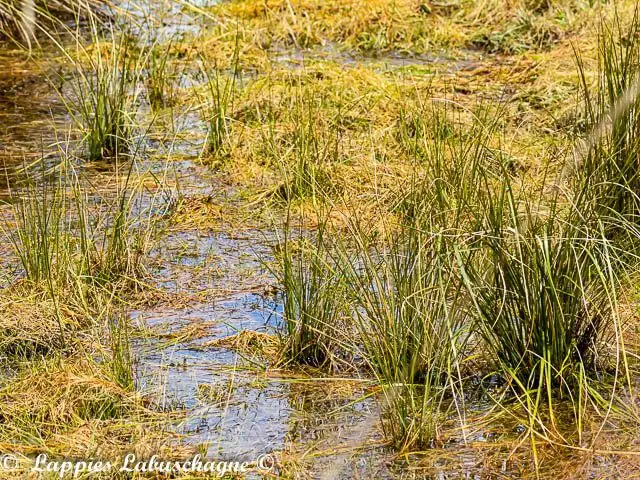
- Prefers standing waters in open landscapes. Especially pools in streams that stop flowing in summer, mostly with a soft (like muddy) and often also sandy bottom, emergent and aquatic vegetation, submerged roots, dead trunks or branches and/or coarse detritus, with bushy fynbos margins and floating leaves of Aponogeton water plants
- Inferred to occur from 300 to 800 m above sea level in the WCP bot close to sea level in the east of the range
Behaviour:
- Males fly across and close to the water surface, regularly landing on perch lengthwise, usually horizontally along twigs or reed stems. Perch close to the water. Females often among males over water but sometimes in bushes or among tall grass some meters from the water. Females often among males over water but sometimes in bushes or among tall grass some metres from the water.
Compared with other species:
- Looks similar to Pseudagrion species but the long curved blackish inferior appendages is diagnostic.
- Metacnemis valida, Blue Riverjack is a ECP species but is light blue with black.
Distribution:
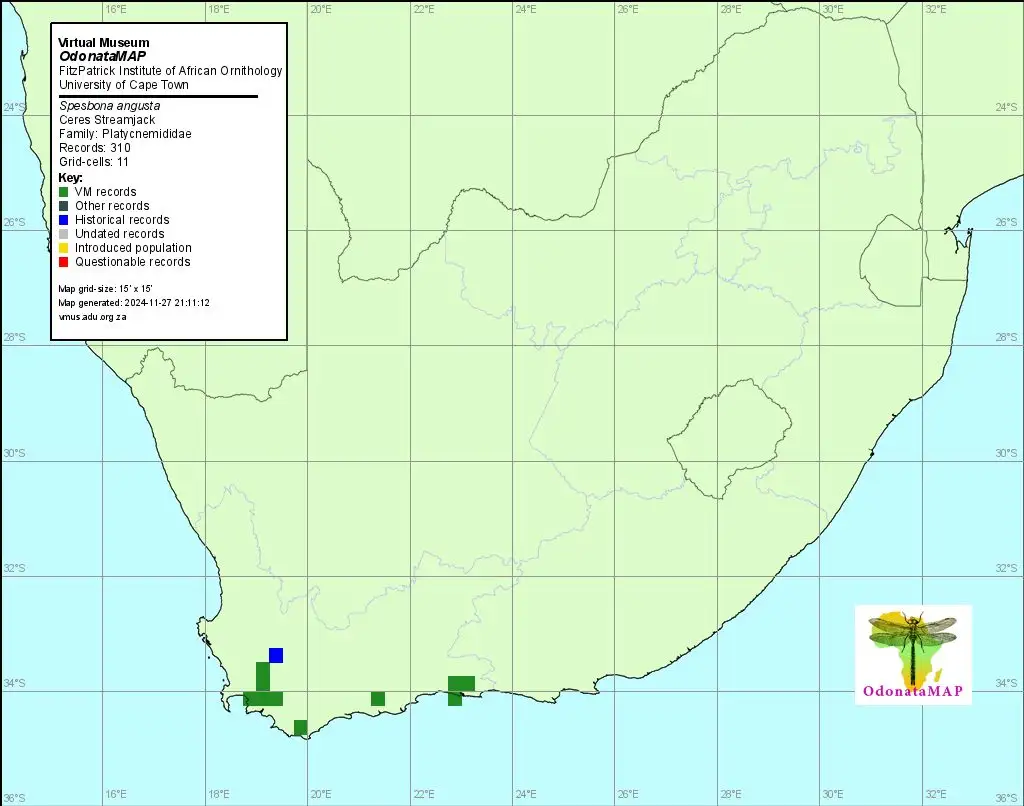 Disibution Map
 Political Map
 Topographical Map
South Africa:
- Endemic to South Africa
- Vary rare endemic and localised. Found from Ceres to the lower reaches of the Du Toit’s river near Franschhoek Recently found in the Sedgefield area ECP.
Further reading:
Websites
A Visual Guide to the Damselflies and Dragonflies of South AfricaAfrican Dragonflies & Damselflies OnlineThe IUCN Red List of Threatened Species Endangered
Odonata Atlas of Africa VMU Number 662140
Credit to Michael J Samways and John P. Simaika for the description
Manual of Freshwater Assessment for South Africa:Dragonfly Biotic Index A SANBI Production