


Common Thorntail, Ceratogomphus pictus, Gewone Doringstert.
 Male
Male Male
Male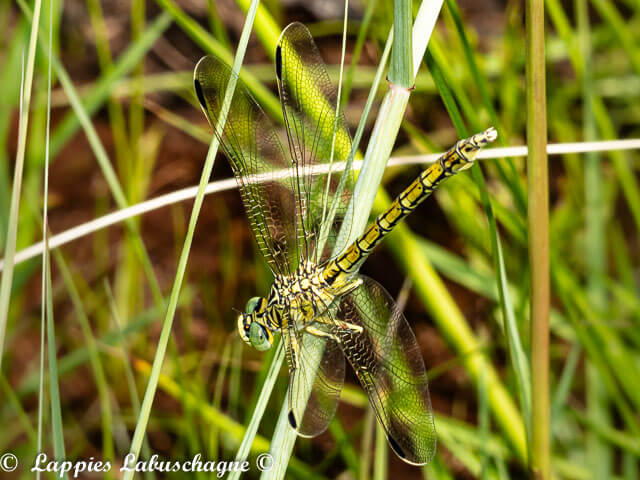 Female
Short description:
- Common Thorntail, Ceratogomphus pictus, Gewone Doringstert is medium sized yellow, greenish yellow and brownish black, with a narrow club formed mostly by large foliations at the end of the abdomen. It has a sharp, forward-pointing dorsal spike (thorn, hence the name Thorntail) on the last abdominal segment.
More Images:


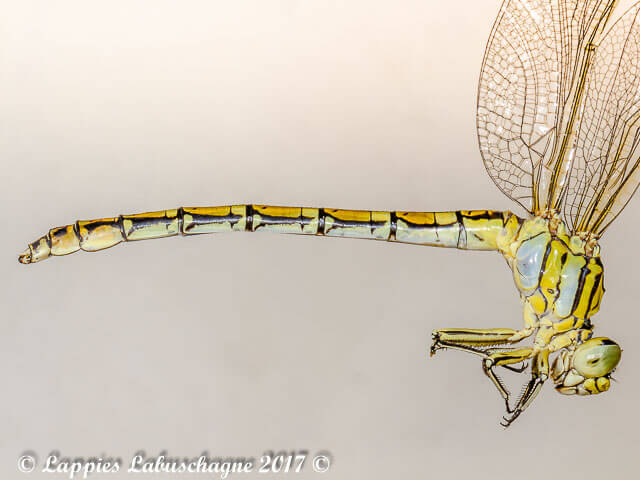
Click on all images to enlarge or view more
Key identification features:
Male:
- Face yellow, labrum yellow with three black transverse lines. Clypeus light yellow. Frons greenish yellow with two black bands running across in front. Head black above with central yellow dot, back of head yellow with black margin .

- Eyes dark greyish blue above and light greyish blue below.

- Thorax has white, greenish yellow to yellow stripes, with brown diagonal stripes separating the yellow/white stripes. Dorsal abdomen with smooth tiger-like stripes.
- Wings clear, with faint greenish tint and prominent yellow costa. Pterostigmas of moderate length (4 mm), black.
- Abdomen has series of broken black and yellow rings on the abdomen with narrow strait foliations on S 8. The foliations have a diagnostic thin black line on the lower border. There is a strong forward pointing spike on s 10 that folds into s 9 when the abdomen is held straight rendering the spike invisible. When s10 is held in a downward pointing posture the spike is clearly visible. Claspers short black with yellow. Lower clasper club-like, sharply curved upwards with dark protrusion on lower half

- A dark variant is also found.
Female:
- Brighter with smaller foliations and no spine on S 10. S 9-10 downwards curved.


- A dark variant is also found.
Habitat:
- Prefers open margins of large and small water bodies, streams, rivers, standing waters in open landscapes and open areas in forest. Often with rocks and a gravelly and/or sandy bottom, probably especially calm sections (like pools) with coarse detritus. Also easily colonises newly created trapped bodies of water (unusual for Gomphids).
- From 0 to 2100 m above sea level, but mostly between 700 and 1900.
Behaviour:
- It perches on the ground, frequently rests on bare patches of soil or on a small boulder.
Compared with other species:
- Ceratogomphus triceraticus, Cape Thorntail
 is larger in size and overall darker than C. pictus (Common Thorntail) which is more yellow. Black markings on thorax, abdomen and foliation are considerably darker in C. triceraticus.
 - The yellow thorax stripes, abdominal markings can be confused with Lined Claspertail, Onychogomphus supinus
 and Clubbed Talontail Crenigomphus hartmanni),
  Correlate identity with the club and clasper structures
Identification guide
- Click HERE for a list of southern African Clubtails by image
- Click HERE for an identification guide for Clubtails based on images of the thorax
Images of southern African Clubtails


 Yellowjack


 Great Hooktail

Distribution:
 Distribution Map
 Physical Map
 Political Map
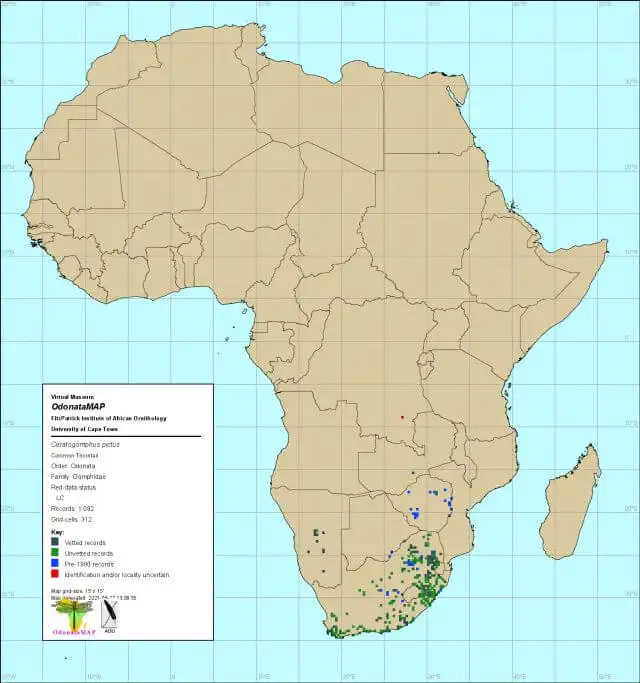 Distribution Map
 Physical Map
  Political Map
South Africa:
- Found all provinces except dry areas of Northern Cape Province
Africa:
- Botswana; Democratic Republic of the Congo; Mozambique; Namibia; Republic of South Africa; Zimbabwe
Further reading:
 A Visual Guide to the Damselflies and Dragonflies of South Africa
 The IUCN Red list of Threatened Species